Make AI Agent (New) app
The Make AI Agent (New) app is available on all plans using Make's AI Provider, with the option to use custom AI provider connections on paid plans. The app is in open beta; product functionality and pricing may change.
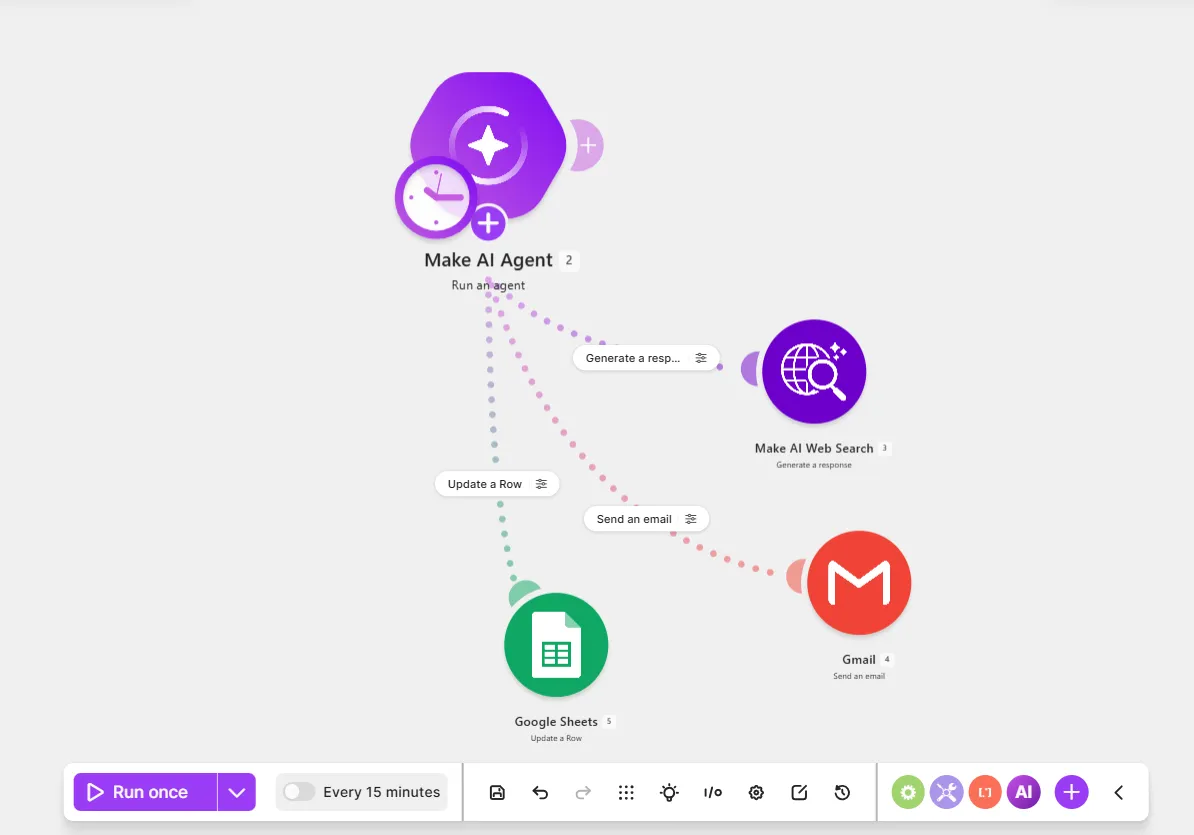
Make AI Agent (New) is an app for creating agents, adding their tools and knowledge, and testing them using a chat interface. This article is a reference for the app's modules, module settings, and outputs.
Module settings
Use this section as a reference for Make AI Agent (New) app modules and their settings.
Run an agent
Use the Run an agent app to create agents, add tools and knowledge, and chat for testing purposes.
Below is a reference for key fields in module settings:
Knowledge
Upload files so your agent has the additional context to tailor its responses to your goals. Knowledge files are typically static, for example, company guidelines, glossaries, and style guides.
See Knowledge file requirements for knowledge file limitations.
Add tool
Give your agent Make tools (modules or scenarios) to perform its tasks.
Each tool corresponds to a specific module:
- Module: The module for a specific third-party service and action, for example, Gmail > Send an email
- Scenario: The Scenarios > Call a scenario module
Add MCP
Give your agent access to tools from third-party MCP servers. Each MCP server added appears on the canvas as an MCP Client > MCP Tools module.
Chat
Interact with your agent to evaluate its performance before going live. Send sample tasks and adjust the agent settings based on the results.
Connection
Select the AI provider that connects your agent to a large language model (LLM).
The AI provider available depends on your plan:
- Make's AI Provider is available on all plans.
- Custom AI provider connections are available to paid plans.
Model
Select an LLM from your AI provider. Models vary in processing speed, reasoning abilities, token cost, and effectiveness for specific tasks.
Enable fallback connection
Toggle to add a backup connection for your agent. If the primary connection fails, for example, due to an outage, timeout, rate limit, or invalid or expired configuration, Make automatically retries the run once using the fallback connection instead of failing the run.
Fallback connection
Select Make's AI Provider connection to use as a backup for the primary connection.
Fallback model
Select a different model than your primary connection’s to protect against model-specific outages.
Instructions
Clearly and systematically describe what the agent does, including its role, behavior, goals, and workflow steps. The agent follows its instructions across all tasks.
Input
Add a specific task or incoming data for the agent to work on. Map data from previous modules, such as chat messages, emails, customer names, and other values.
Input files
Upload a file for your agent to process with its task.
File limitations include:
- Make's AI Provider, OpenAI, Anthropic Claude, or Gemini only
- A model that accepts files
- JPG, PNG, GIF, and PDF for the input files you give the agent
- PDF, DOCX, TXT, and CSV for the output files you ask the agent to generate
Input files > File name
Name your file.
Input files > Data
Map the file from a previous download file module, such as Google Docs > Download a file.
Conversation ID
Specify a custom ID so your agent keeps user interactions in the same communication thread and remembers them.
Examples:
- A mapped userId to remember conversations with a specific user, in the case of multiple users
- A mapped timestamp of the first message or email to remember the entire thread and reply
- A unique combination of characters to remember your requests
If you leave this field blank, your agent generates a unique ID for each scenario run and has no memory of previous communication.
Maximum conversation history
Define the maximum number of replies the agent remembers in a conversation.
Step timeout
Enter the maximum number of seconds an agent runs in each step before it fails. The maximum timeout is 600 seconds (10 minutes).
If you leave this field blank, the timeout defaults to 300 seconds (5 minutes).
Response format
Specify the response format that the agent returns.
Response format > Text
Returns a response in text format.
Response format > Data structure
Returns a response in a custom format, either as output items (Add item) or as a content type, such as JSON (Generate).
Output
The Output tab of the module output shows the agent's response and execution metadata. To open it, click the output bubble of a module, go to the Output tab, and expand fields in the input and output bundles.
Below is a reference for key fields in the output:
Response
The agent's answer to the user request. Map the response to other modules to use it elsewhere.
Metadata
The agent's execution steps and token usage summary.
Metadata > Execution steps
The agent's decision-making process in chronological order. Each step describes factors such as the role behind the step, the tool used, and the tokens consumed.
Metadata > Token usage summary
The tokens used in a single run, including Prompt tokens (input), Completion tokens (output), and Total tokens.
Reasoning
The Reasoning tab of the module output shows how the agent processes data and responds to requests step by step. To open it, click the output bubble of a module and go to the Reasoning tab.
The tab includes:
- The instructions and inputs the agent used to generate a response
- The agent's processing speed in seconds
- What the agent was thinking (shown when a reasoning model is used and the task requires deeper reasoning)
- How much of the context window was used
- If fallback connection triggers during a run, the Reasoning tab also shows the Primary connection failed and Using fallback connection entries.
Context usage
Context usage in the Reasoning tab shows how much of your model's context window was used in a scenario run.
The context window is the maximum amount of data a model can process in a single run. Your AI provider sets this limit, and it varies by model. Context usage is measured in tokens.
To check context usage, hover over the Context usage icon next to Agent response. For example, 575/400.0k tokens (0.1%) means 575 tokens of the 400,000 available tokens were used (0.1%).
You receive an error message when the context window is exceeded. To resolve it:
- Upload a smaller file.
- Upload the file as a knowledge file.
- Reduce the number of tools or use different ones.
- Define a maximum number of replies to use as context in Maximum conversation history in the agent's Advanced settings.